


970x125
In a country where EVs are still a rare sighting, Japan’s legacy carmakers such as Toyota, Honda, Nissan and Suzuki, and upstarts such as Hiroshima-based KG Motors, are trying to bust an established tenet: that bigger is better when it comes to electric cars. There is another serendipitous outcome that Japan’s EV development pursuit seems to be achieving in the process — price parity with internal combustion vehicles that is practically elusive in most other markets.
970x125
KG Motors, for instance, has developed a battery-powered one-seater that looks more like an overbuilt golf cart than a modern EV like the ones the Chinese seem to have perfected. Despite that, well over half of the 3,000 units it plans to deliver in 2027 have already been pre-sold to customers here.
KG Motors’ formula seems to hold the key for automakers in Japan, where uptake of EV has been slow. The solution: upend the script and focus on one of the country’s most popular forms of transport, mini or the so-called kei category of vehicles.
Kei car specialist Suzuki Motor Corp line-up at the 2025 edition of the Japan Mobility Show included EV concepts such as the diminutive ‘Vision e-Sky’ aimed at the Japanese market and a mini-commercial electric van developed jointly with partner Toyota Motor Corp. Successor to the 70-year-old Tokyo Motor Show that serves as a co-creation platform, bringing together companies across Japan’s automotive and ancillary sectors, the Mobility Show showcased the country’s distinctive pursuit of the electric future.
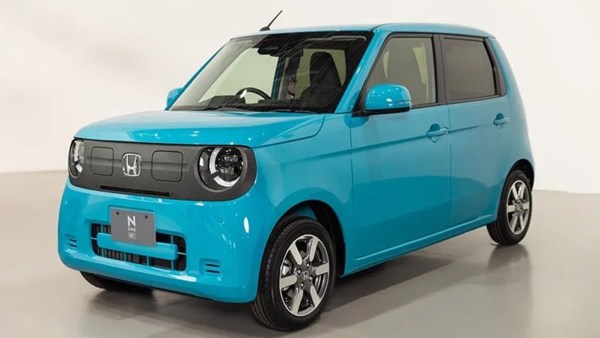 Honda has started selling its first new electric kei car called the N-ONE e (right) in the Japanese market (Credit: Honda Motor Co)
Honda has started selling its first new electric kei car called the N-ONE e, which has been launched for the Japanese market that features a retro, boxy design typically of what are called kei cars. Toyota has mini cars launched through its Daihatsu division, while Mazda and SUV maker Subaru too have thrown their hats in the ring.
EVs: Dimensions and range proposition
EVs typically tend to have longer dimensions in order to accommodate larger battery packs along the base of these vehicles, in order to provide a sufficient driving range. Driving range has been a key selling proposition for EV, especially in the United States and Europe. But there is a tradeoff: A larger battery pack increases kerb weight of the vehicle, and unless battery efficiency improves, there is a cost to carrying a larger and heavier battery onboard. A bigger battery also means longer charge times.
Japan is a market that seems determined to break that trend. China too has veered around in that direction, with the Wuling Hongguang Mini EV recorded as a consistent top selling EV in the country before being displaced by the Geely Geome Xingyua.
Story continues below this ad
Kei cars — compact vehicle categories unique to Japan — have always been extremely popular in that country. The body is smaller than a normal passenger car, and so is the engine displacement, typically under 660 cc. Those compact specs mean it is cheaper to run and easier to park, and the taxes on the cars are lower than for standard passenger vehicles. The compact dimensions of kei cars benefit from lower taxes and insurance in the Japanese car industry.
Industry data from Japan show that Kei cars accounted for more than one-third of all new vehicles sold in Japan in the fiscal year through March. “The kei experiment has stood the test of time, having survived over 70 years and ending up shaping the Japanese car industry we see today. The boxy design is testament to the manufacturers’ pursuit to make the most of the dimensions on offer — the length, breadth and the height,” a senior executive with one of the legacy Japanese manufacturers told The Indian Express.
Nissan Motors and Mitsubishi Motors are already selling electric Kei cars launched three years back and now China’s electric vehicle major BYD, plans to start selling mini EVs in Japan by late next year.
EV challenge to Japan’s global domination
Japan’s Battery Electric Vehicle market is still small at less than 2 per cent of registered passenger cars in recent months. But with a lot of incentives thrown in, the price of a kei EV is only slightly higher than a combustion engine kei car — a significant differentiator from other key markets. Most experts, though, believe that it’ll be some time before sales of EV cars gain traction in Japan, given that most owners currently use EVs not as their first cars. Also, in Japan, only about one-third of the household have more than one car. For EVs to take off in Japan, there could be an expectation that driving ranges come close to matching those of internal combustion engine cars and there are more charging stations visibly installed in Japanese towns and cities.
Story continues below this ad
All of this also comes at a time when Japanese car makers are seeing one of the biggest threats to their global domination of the automobile industry that they have ever seen — the delay in adapting to the EV future. Automakers such as Honda and Nissan tried merging to pool in resources, but that deal is now off.
There is still discussion of Japan’s global dominance, which transcended consumer electronics to extend to cars, but now that is under threat with the EV onslaught and China’s ascendence. Nissan, one of the world’s pioneers of electric vehicles with its brilliant Leaf model, has somehow lost its edge. But Japanese carmakers such as Toyota and Honda are leaders in hybrids, and alternative technologies such as hydrogen fuel cell vehicles. One reason why the Japanese carmakers never committed fully to EV technology.
There are two upsides to the Japanese EV challenge. One, Toyota and Nissan are putting in money into solid state batteries, which promise to be cheaper to build, offer longer range and are quicker to charge. Two, the Kei car based EV push could yield something of a new template that could work particularly in Asia. China is already seeing that promise unfold.
(The writer was in Japan at the invitation of Maruti Suzuki India)
970x125
