

970x125
Growing up in Bermuda, I remember my family restocking our hurricane supplies every summer. Although some hurricane preparedness must wait until the storm is closer (like boarding up windows and securing patio furniture), stocking up on essentials can—and should—be done before a storm is even spotted on the horizon.
970x125
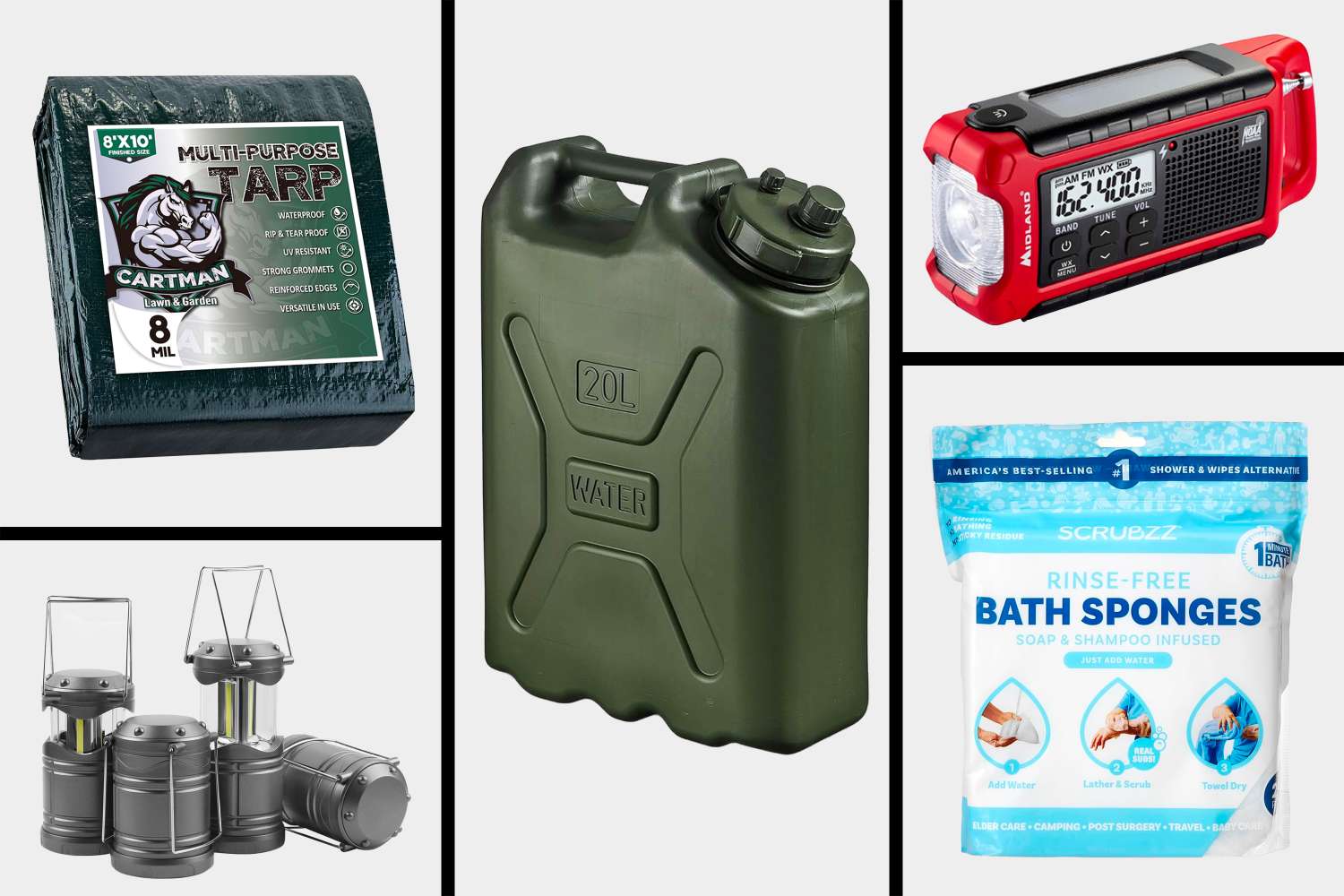
For instance, gathering non-perishable foods is a critical step, and it’s wise to have cash on hand, since ATMs and card machines will likely be down. Many people who live in areas that get frequent storms opt to invest in a generator. For other supplies you’ll want to buy ahead of time, I spoke to three experts who gave advice on the items you don’t want to skip, such as a large tarp to cover damage to a roof or water storage containers to fill in advance.
While the list below can help in emergencies, meteorologist Rob Jones stresses evacuating when told to do so “is the most important thing you can do to stay safe.”
Water
Amazon
Having enough water can be a matter of life or death in an emergency. “You need one gallon of water per person, per day for at least a week,” says Dr. Jeffrey Lindsey, PM, EFO, fire and emergency services director at the University of Florida. Investing in water storage containers can help you prepare, since they can be filled with fresh water before the storm arrives. Additionally, you can stock up on sealed water containers from the grocery store, which Lindsey recommends doing now, since there won’t be such high demand at the store—and sealed water doesn’t go bad.
In addition to fresh drinking water reserves, Lindsey recommends storing buckets of water prior to the storm for flushing toilets. “Water sources can become contaminated,” he warns. “You need water to survive and, in many cases, to cook and bathe with.”
Batteries
Amazon
Strong winds and rain inevitably lead to power loss during hurricanes; even weaker tropical storms can cause blackouts. “Nighttime becomes very bleak without light,” shares Lindsey. He recommends having batteries for all your electronics ready and accessible, for both your flashlights and lanterns, as well as creature comforts like fans. Stocking up on a combo pack is the best idea to make sure you can power a variety of electronics. To make sure you know exactly what you have on hand, buy a battery organizer and storage case so you can see everything at a glance. This kit even has a tester so you can tell if your batteries are still good.
Portable battery-powered light
Amazon
When Hurricane Fabian hit Bermuda in 2003, we didn’t have power for nearly two weeks. To echo Lindsey’s previous sentiment—nighttime became a dreaded routine. Battery-powered LED lights can help ease that feeling, whether you’re using them to play games or just to not feel so ominous.
“I really like the small collapsible battery-powered LED lights,” shares Carrie Stevenson, a Coastal Sustainability Agent with expertise in hurricane preparation, mitigation, and recovery. “They can function as small flashlights for moving around the house when the power is out, and then pop up to serve as small lanterns to read or play games by when you’re in one location for a while.”
Solar-powered garden lights are a great option too; ”They can be brought inside for a little lighting at night and put back outside in the daytime to recharge,” adds Jones. Just be sure they’re not outside for when the storm actually hits, or they’ll likely blow away!
Waterproof bags
Amazon
Keeping important documents in waterproof bags or containers is a smart step to take before a storm hits. “These documents are complicated to replace and helpful when trying to get life back to normal,” adds Stevenson. “Putting everything in one, waterproof location makes it easy to retrieve in a hurry and transport safely in bad weather conditions.” Opt for something like these waterproof (and fireproof) document bags or plastic bins designed to keep water out.
“Plastic bags are one of the most important, underrated items to have on hand,” says Jones, who recommends a simple solution of stocking up on various sizes of Ziploc bags to protect documents. “They are great for keeping documents (IDs, birth/citizenship certificates, insurance paperwork, passports, emergency contact information) dry if you don’t have a proper water-tight safe,” he says.
Ziplocs can also be used to make ice packs—fill them with water, then keep them in the freezer to allow your perishable goods to stay cooler longer if the power goes out (then it’s an extra source of clean water after the storm once it’s melted). More bags to have on hand include thick black contractor bags, which Jones says are “great for keeping larger items covered up, but can also be used as a poncho in a pinch, and bulk water storage.”
Portable fans
Amazon
After a hurricane, it’s typically extraordinarily hot and humid. “All the rain has passed through—the weather is often beautiful—but it is hot and the power is out, so there’s no A/C,” explains Stevenson. Further, for two to three days after the storm has passed, you’re usually out in the yard cleaning up debris, downed limbs, and assessing potential home damage, “so having a way to cool down is important,” stresses Stevenson. It’s best to keep a couple of battery-operated fans around the house to get some air flow, and as long as you’re stocked up on batteries, this is a sure reprieve from the exhausting heat.
Hand sanitizer and wipes
Amazon
You never know how much you miss a shower until it’s been multiple days in the heat and humidity, and all you can think about is cold (yes, cold) water running over you. At least, that’s what I remember from the long days without power in the wake of a hurricane. “If the water goes out, having a way to clean up is really important,” says Stevenson. Stocking up on wipes is smart, like Purell Hand Sanitizing Wipes for an easy way to keep hands clean, or body wipes that can take the place of a shower for the time being.
Tarps
Amazon
When Stevenson used to work in an emergency operations center she took community calls after storms; there, she says the number one request was a tarp to cover roof leaks. “Stores run out of them quickly, so keep some on hand,” she advises. “It’s a very ‘after’ sort of need, so I think people forget it ahead of time.”
Manual can opener
Amazon
When most people put together hurricane kits, they stock up on canned, non-perishable items. Except when they go to open those items, they either don’t have a can opener or were planning on using their electrical version (which obviously won’t work without power). “Make sure you have a manual can opener,” says Lindsey. This way, if you lose power, you will be able to open your canned food.
Hand crank radio
Amazon
Hurricanes, like any weather pattern, are unpredictable. They come with different threats that change hourly, if not by the second; this I know firsthand, as tropical storms would quickly pick up to a category 1 or 2 storm and surprise islanders. Or, in Jones’ case last year, his neighborhood in Florida experienced a storm surge threat and river flooding days after the heavy rainfall that occurred with Hurricane Milton.
“The double whammy of threats meant some people were forced out of their homes twice,” he shares. For this reason, it’s essential to stay informed, so Jones advises investing in a hand crank all-in-one weather band AM/FM radio. It’s not just a radio—it’s a flashlight, phone charger, and whistle. “I have an older one myself, but if I were in the market to buy a new one today, then I would recommend one like the Midland ER310.”
Entertainment pack
Amazon
When it comes to post-hurricane survival, Jeff Schlegelmilch, MPH, MBA, director of the National Center for Disaster Preparedness at Columbia Climate School, Columbia University, says, “It’s not just about our physical health, but also our mental health.” He says that children are particularly vulnerable to disruption in routine in the uncertainty of disasters, so having a comfort item for them is critically important.
If you have to evacuate, make sure to pack their favorite stuffed animal, toy, or game. As a kid, I vividly remember playing multiple rounds of Monopoly with friends after hurricanes—it kept us distracted while our parents could tend to the clean up without having to worry about us. For adults, Schlegelmilch says, a deck of cards can go a long way. “There is a lot of downtime in disasters, [and] the waiting can be the most draining. The big things keep you alive, the little things get you through it.”
Love a great deal? Sign up for our T+L Recommends newsletter and we’ll send you our favorite travel products each week.
970x125
