

970x125
Copenhagen: The European Union (EU) environment ministers held a policy debate on a proposal to amend the European climate law to establish a binding intermediate climate target for 2040 on Thursday.
970x125
During a meeting in Brussels, the ministers also discussed the EU’s updated 2035 nationally determined contribution (NDC) to be submitted to the United Nations Framework Convention on Climate Change ahead of the UN Climate meeting (COP30).
The ministers also discussed a “statement of intent” that should provide international clarity about the state of the debate as the EU may not be able to submit its 2035 nationally determined contribution (NDC) to the United Nations Framework Convention on Climate Change next week, sources said. The NDC may now be expected a few days ahead of the UN Climate meeting (COP30).
The statement of intent released late on Thursday says, “EU and its Member States, acting jointly, will be submitting the next NDC of the EU with an indicative 2035 target of reduction in net GHG emissions of a number expected to be between 66.25% and 72.5% compared to 1990 levels. The range has been criticised by environmental groups for being not as ambitious as they had expected.
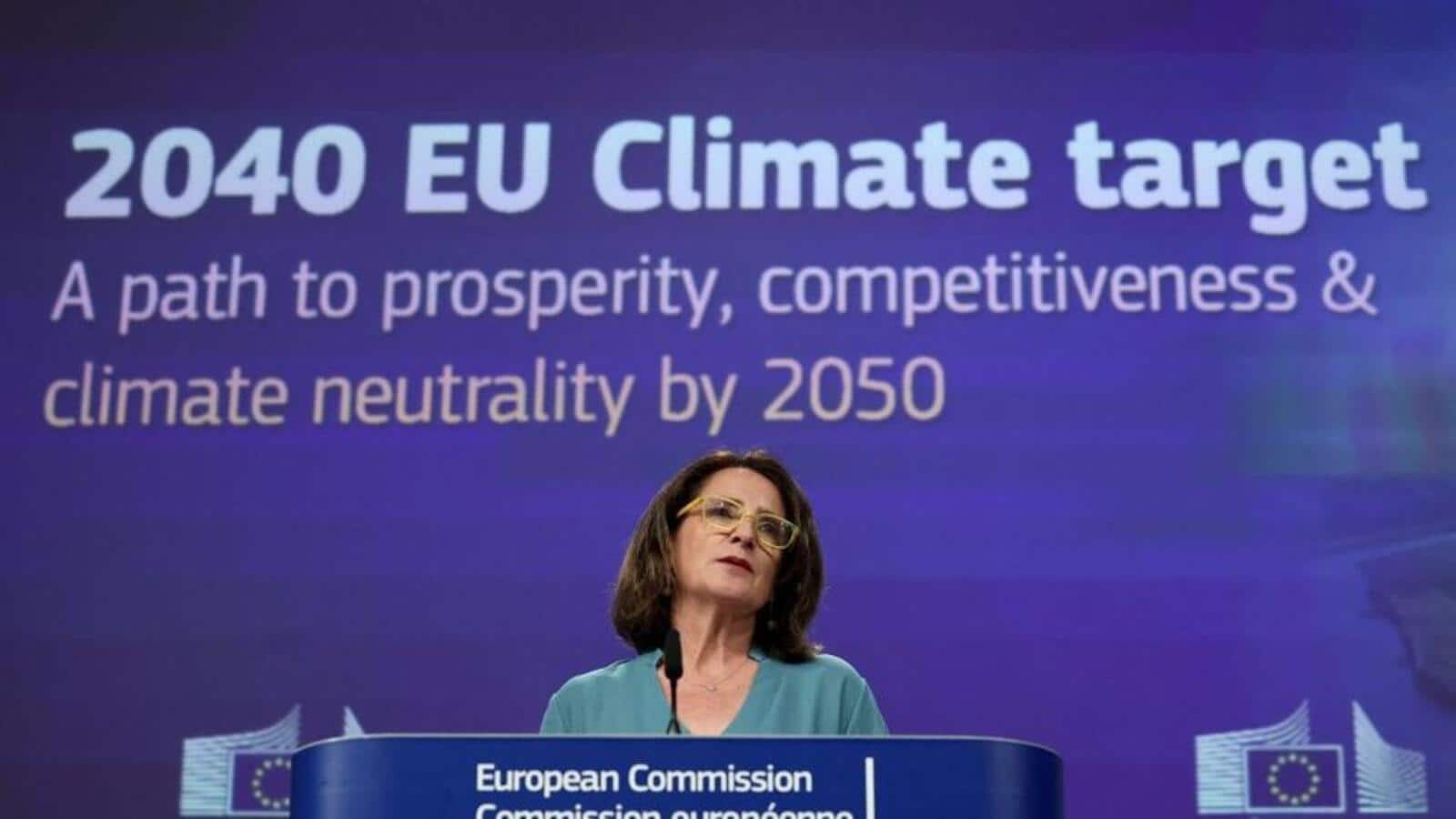
EU has set its climate targets for 2030 and 2050 in regulation establishing the framework for achieving climate neutrality under the European Climate Law. Article 4(3) of the law requires an intermediate 2040 climate target to set the pace for EU-wide reductions of net GHG emissions. “Setting a 2040 target will provide investors and EU businesses with predictability and a clear indication of the transition pathway needed, to drive business decisions and unlock private investment,” the EU proposal said.
On February 6, 2024, the European Commission published a communication on the Union’s climate target for 2040, setting a path from the already agreed intermediate 2030 target to climate neutrality by 2050. “A 90% target puts the EU on the pathway which provides the greatest overall benefits in terms of competitiveness, resilience, independence, autonomy, a just transition and ensuring that the EU meets its commitments under the Paris Agreement. The EU recognises climate change as an existential threat closely linked to global security, peace and sustainable development. With the 2040 target the EU stays the course on its climate action while continuing to diplomatically engage partner countries to reduce global emissions and reach climate neutrality,” the proposal, on which ministers debated, added.
Countries are expected to present their 2035 targets during the UN’s General Assembly in New York on September 24. China is expected to announce its target there. A potential EU official statement with a range, promising to update their NDC once a 2040 target is agreed, is seen as “a clever way forward” for European leaders to “speak with one voice” at the summit, those aware of the matter said.
HT reported on September 15 that as the COP30 approaches, experts are concerned that climate change is not being prioritised by parties, owing to a number of factors including lack of political consensus, a difficult geopolitical situation and the impact of unilateral trade measures.
The biggest challenge for the EU though is to build consensus among all 27 EU countries to endorse an ambitious NDC, according to those aware of the matter. Experts have said there is a leadership vacuum this year as US has announced that it will withdraw from the Paris Agreement; EU is still trying to forge consensus on an ambitious NDC as Germany; France and Hungary have not yet come on board according to those aware of the matter. An EU NDC may still come through ahead of COP30 but experts are concerned that EU is not taking the leadership that it is normally expected to. This is mainly partly due to rise of the right wing in certain states which have a different set of priorities; their domestic economic conditions; more investments in defence; US’s withdrawal from Paris Agreement among others, those aware of the matter said.
People familiar with the matter have indicated that China which is expected to submit an economy wide NDC will now take the lead in climate talks.
Also Read: No consensus, global conflicts may hit climate goals
“The Danish Presidency (for EU) is walking a tightrope. On the one hand, it would be very damaging for the EU’s credibility as a climate leader to show up in New York completely empty-handed. On the other hand, it is equally important to avoid being hoodwinked into a premature decision on the EU’s NDC that will, in all likelihood, lead to a non-binding and low-ambition outcome that will impress nobody and simultaneously undermine the process to decide on the EU’s flagship climate target for 2040. The statement of intent, invented by the Danish Presidency as a way to bridge these two concerns, could be a clever way forward that would give the EU some cover in New York while maintaining the pressure to deliver a 2040 target of 90% and an ambitious NDC derived from that before COP30 kicks off in Brazil,” Jens Mattias Clausen, Director, EU Division and responsible for COP negotiations, CONCITO said in a statement on Wednesday.
“We made such big reductions that are actually an example already for the other member states of the United Nations. So I don’t think that we should not be proud of ourselves. We just have to find the correct and proper way how to continue, because we do think that the current goal and current path that we are taking is not entirely what we should be taking. we have to cooperate the businesses, the society. If we lose the support of the society, if we lose our businesses, then it’s going to backfire to the climate change as well,” Anikó Raisz, minister for environmental affairs for Hungary ahead of the meeting.
“This is not a straight line. This will take another round of conversations. But I have been long enough in politics to know that these processes are never like that. So, you of course have every right, also in the next couple of meetings, to ask me why aren’t we there yet. What I can say is that we move forward, two steps forward, one step back, and that is typical, typically the way it is in both domestic and in European politics,” said Wopke Hoekstra, European climate commissioner to reporters gathered at the council.
(Jayashree Nandi is in Copenhagen for the Danida Fellowship Centre’s Learning Programme)
970x125
