

970x125
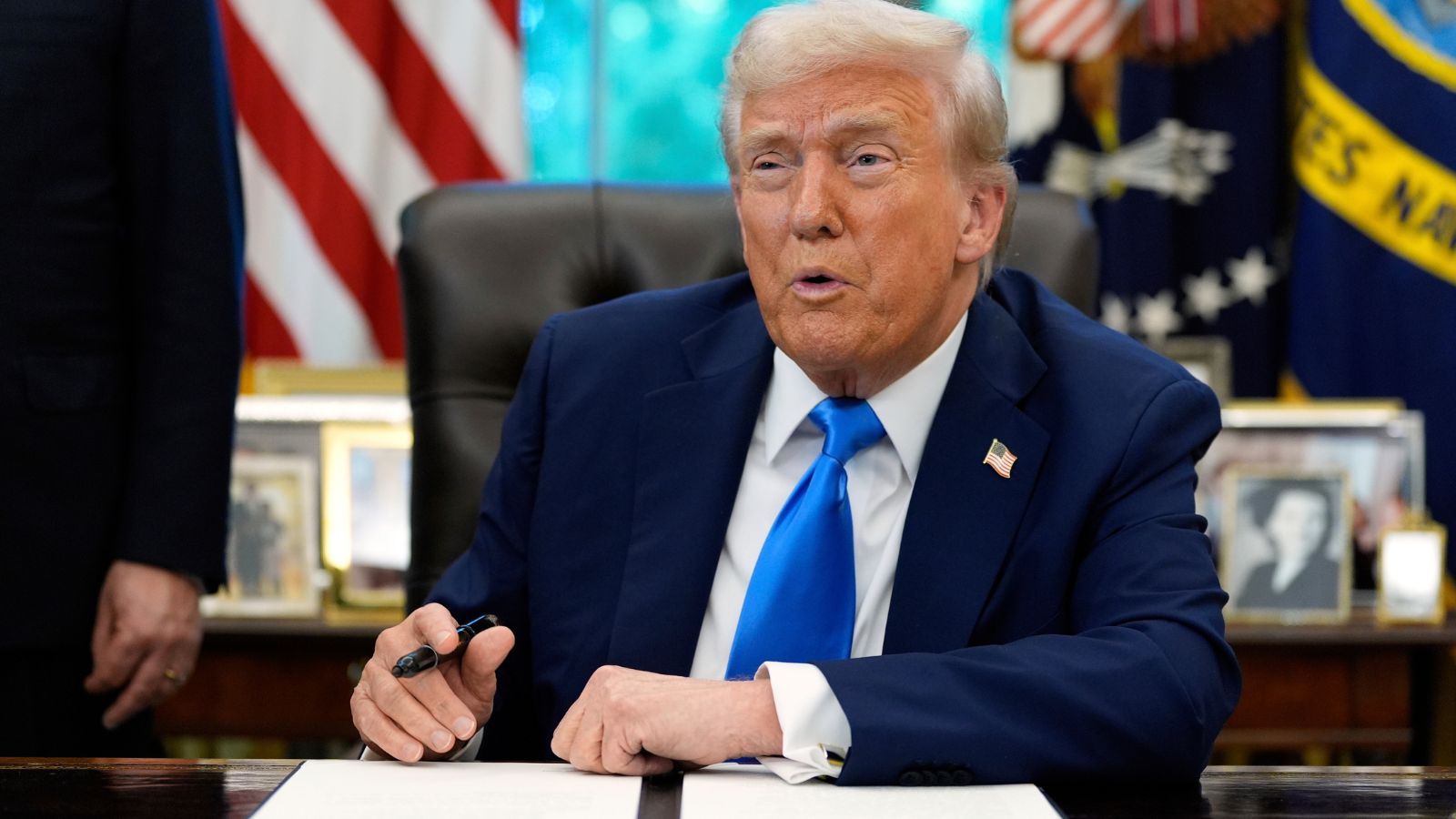
Expanding the tariff net, US President Donald Trump has said his administration will be imposing a 100 per cent tariff on branded or patented pharmaceutical products, a 50 per cent tariff on all kitchen cabinets, bathroom vanities and associated products, and a 25 per cent tariff on heavy trucks from October 1.
970x125
This comes in the wake of the US Department of Commerce launching a range of investigations under Section 232 of the Trade Expansion Act of 1962, which gives Trump the power to raise tariffs citing “national security”.
“Starting October 1st, 2025, we will be imposing a 100 per cent tariff on any branded or patented pharmaceutical product, unless a company is building their pharmaceutical manufacturing plant in America. ‘Is building’ will be defined as ‘breaking ground’ and/or ‘under construction’. There will, therefore, be no tariff on these pharmaceutical products if construction has started,” Trump said in his post on TruthSocial Thursday night.
According to Delhi-based research body Global Trade Research Initiative (GTRI), India’s focus on generics, rather than patented drugs, may shield much of its trade from the full force of the tariff. However, uncertainty remains regarding the treatment of “branded generics” under the new US policy.
The US is India’s largest market for pharmaceutical exports, accounting for an almost 40 per cent share. Pharma exports were exempt from the 50 per cent tariffs imposed by the Trump administration on most Indian goods.
“The grey zone is ‘branded generics’ – generic molecules sold under brand names like Crocin could face tariffs if treated as ‘branded imports’. Many Indian firms sell it to the US,” GTRI said in a note, adding that clarity is likely to emerge only when legal documentation pertaining to this decision is made available.
Following Trump’s announcement, shares of Indian pharmaceutical companies fell Friday, in a reaction that analysts saw as largely sentimental, as most of India’s pharma exports to the US are unlikely to be impacted by this new tariff.
Story continues below this ad
India’s pharma exports to the US are concentrated among a group of major pharmaceutical companies that together account for nearly 70 per cent of shipments, as per GTRI analysis. The companies include Zydus Lifesciences, Dr. Reddy’s Laboratories, Lupin, Aurobindo Pharma, Hetero Labs, Sun Pharma, Eugia Pharma Specialities, Cipla, Glenmark Pharmaceuticals, APL Healthcare, Gland Pharma, MSN Laboratories, Amneal Pharmaceuticals, Mylan Laboratories, Granules India, Alkem Laboratories, Annora Pharma, Alembic Pharmaceuticals, and Unichem Laboratories Limited.
According to HSBC analysts, Sun Pharma is the only Indian company with sizeable sales from patented products in the US. It reported global sales of $1,217 million from patented products in FY25, of which the US market accounted for 85-90 per cent.
“Generic (off-patent) drugs remain exempt from US tariffs, hence there is no impact for other Indian companies,” HSBC analysts said in a note.
The wave of fresh tariffs under Section 232 comes at a time when Trump’s tariff powers under the International Emergency Economic Powers Act (IEEPA) could possibly be curtailed next month if an adverse ruling comes from the US Supreme Court, forcing the administration in DC to remove reciprocal tariffs on countries. India is facing a 50 per cent tariff that is threatening jobs in labour-intensive sectors such as textiles, footwear and marine products.
Story continues below this ad
European countries are expected to face the most immediate and severe impact from the new US tariffs on imported branded or patented pharmaceutical products, while India may remain less affected for now, according to GTRI.
“US import data for 2024 shows total pharmaceutical imports valued at $212.82 billion, with India contributing $12.73 billion or 5.98 per cent of the total. By contrast, Ireland accounted for $50.35 billion (23.66 per cent), Switzerland for $19.03 billion (8.94 per cent), and Germany for $17.24 billion (8.10 per cent). These European countries, which supply high-value branded and patented drugs, are expected to face the most immediate and severe impact from the new tariffs,” the release stated.
India’s contribution of nearly 6 per cent of the total US imports was largely dominated by generic medicines. Citing data from the Directorate General of Commercial Intelligence and Statistics (DGCI&S), GTRI said India exported $9.8 billion worth of pharmaceutical formulations to the US in 2024-25, accounting for 39.8 per cent of its total pharma exports.
These shipments include tablets, capsules, and injectables for the treatment of hypertension, diabetes, infections, cardiovascular, and neurological conditions. Large volumes also cover antibiotic formulations such as amoxicillin, azithromycin, and ciprofloxacin, as well as vitamin and nutritional products.
Story continues below this ad
“For now, India’s low-cost generic model may offer a cushion against the shock of Trump’s tariff. Policymakers and exporters will be watching closely for clarifications from Washington in the coming days to assess the share if all of India’s $9.8 billion pharmaceutical trade with the US will stay unaffected or face disruption in branded product lines,” GTRI said.
Trump’s move could also affect government incentives under the Production-Linked Incentive (PLI) schemes that are focusing on developing products under three categories. According to an official statement, the first category covers biopharmaceuticals, complex generic drugs, “patented drugs or those nearing patent expiry”, gene therapy drugs, orphan drugs and complex excipients.
The PLI Scheme for Pharmaceuticals was approved by the Union Cabinet in 2021, with a financial outlay of Rs 15,000 crore and a production tenure running from FY 2022-23 to FY 2027-28.
“Under this scheme, high-value pharmaceutical products such as patented/off-patented drugs, biopharmaceuticals, complex generics, anti-cancer drugs and autoimmune drugs, among others, are manufactured,” the government said in April this year.
Story continues below this ad
The US has been increasingly using Section 232 to impose tariffs on specific products such as steel and aluminium. Among the new investigations launched by the US were probes into pharma and pharma ingredients.
After imposing 50 per cent tariffs on steel, aluminium and copper using Section 232, the US Department of Commerce opened fresh investigations into timber and lumber, semiconductors and semiconductor manufacturing equipment, pharma and pharma ingredients, trucks, processed critical minerals, commercial aircraft and jet engines, polysilicon and its derivatives, wind turbines, and unmanned aircraft systems along with their parts and components. The product list could expand further going forward.
While tariffs under Section 232 are far less sweeping than reciprocal tariffs that Trump managed under IEEPA, the former provides much stronger legal cover, as the US Supreme Court has on multiple occasions refused to entertain challenges due to the “national security” element in the statute. India has also invoked “national security” to restrict the entry of goods in the past, and at the WTO, what measures fall under national security has been a hotly contested issue due to its broad scope.
970x125
